Dividends: Definition, Properties, Applications, and Examples
Publish Date: 08 Aug, 2023
Table of Content
Mathematics enclose a wide range of principles and concepts, and dividend plays a vital role in several mathematical operations.
An understanding of dividends is crucial for performing accurate calculations, solving equations, and interpreting real-life scenarios. Let's explore the fundamental concepts and definitions associated with dividends.
Understanding Dividends in Mathematics
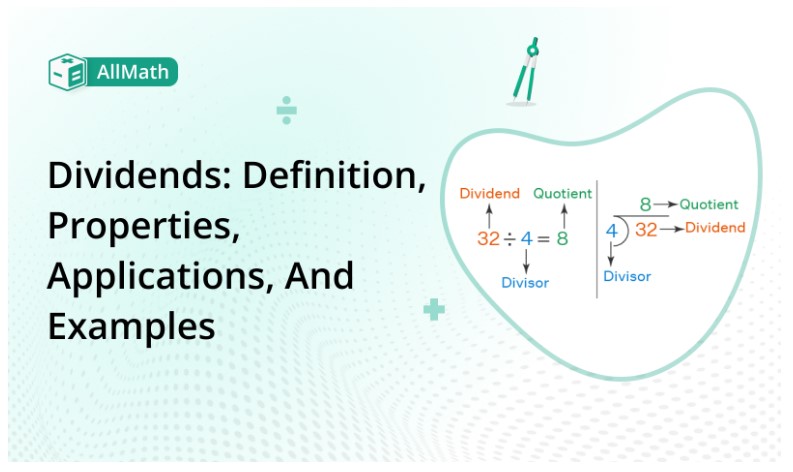
Dividend refers to the quantity being divided in a division operation. In order to get the quotient, one quantity is simply divided by another amount, known as the divisor. The division is a basic mathematical operation that heavily depends on the dividend.
Basic Concepts
To better understand dividends, let's familiarize ourselves with some basic concepts and definitions related to this mathematical term.
- Dividend
- Divisor
- Quotient
- Remainder
- Division
Dividend
The number or value being divided in a division operation. For example, 36/9 = 4
In this example, 36 is a dividend.
Divisor
The number or value by which the dividend is divided. For example, 36/9 = 4
In this example, 9 is a divisor.
Quotient
The result is obtained after dividing the dividend by the divisor. For example, 36/9 = 4
In this example, 4 is a quotient.
Remainder
The amount left over when the dividend is not evenly divisible by the divisor.
Division
The mathematical operation of separating a quantity into equal parts or groups.
Properties of Dividend
A dividend possesses several properties that influence its behavior within mathematical operations. Understanding these properties allows for more effective problem-solving and accurate calculations. Let's explore some key properties of dividends:
- Identity Property
- Zero Property
- Divisibility Property
- Associative Property
Identity Property
When 1 divides the dividend, the quotient remains equal to the dividend.
Zero Property
Dividing any number by zero is undefined, as division by zero is not permissible.
Divisibility Property
The dividend can be evenly divided by the divisor, resulting in a whole number quotient.
Associative Property
Grouping numbers within a division operation does not affect the final quotient.
Dividend in Real-Life Applications
Dividend finds their application in numerous real-life situations. From sharing resources among a group of individuals to calculating average scores, dividend plays a significant role in day-to-day calculations. Some common instances where the dividend is utilized include:
- Sharing Resources
- Calculating Averages
- Allocation of Time
- Business Profit Distribution
Sharing Resource
Dividing resources, such as money or items, equally among a group of people.
Calculating Averages
By dividing the sum of a set of numbers by the count of those numbers we can determine the average value.
Allocation of Time
Distributing time slots among different activities based on specific criteria.
Business Profit Distribution
Sharing the profits generated by a business among its stakeholders.
Use of dividends in different mathematical terms
- Dividend in Algebraic Equations
- Dividend in Fractions
- Dividend in Decimals
- Dividend in Percentages
- Dividend in Problem-Solving
Dividend in Algebraic Equations
Algebraic equations involve variables, constants, and mathematical operations, including division. Dividend plays a crucial role in solving algebraic equations. Let's explore how dividend comes into play in algebraic equations:
Simplifying Equations: Dividing both sides of an equation by a specific number can help simplify the equation and isolate the variable.
Solving for Unknowns: When solving equations with unknown variables, dividing by the correct dividend allows us to find the value of the variable.
Dividend in Fractions
Fractions represent parts of a whole, and dividend plays a significant role in fraction calculations. Let's understand how dividend operates within the realm of fractions:
Fraction Division: The dividend is multiplied by the reciprocal of the divisor before being divided by it when dividing or multiplying two fractions.
Dividend in Decimals
Decimals are a representation of numbers with fractional parts. The dividend is essential in decimal operations, particularly division. Let's explore the role of dividends in decimal calculations:
Decimal Division: Dividing a decimal number by another decimal number involves dividing the dividend by the divisor and adjusting the decimal places accordingly.
Dividend in Percentages
Percentages represent proportions or fractions of 100. The dividend is instrumental in percentage calculations, as it helps determine the proportionate value. Think about it:
Calculation of percentage: To get the stated amount, divide the dividend by the entire value. Then, multiply the result by 100.
Dividend in Problem-Solving
The concept of dividends plays a pivotal role in mathematical problem-solving. Dividing a given quantity into equal parts helps solve various types of problems. By understanding how dividend interacts with other mathematical concepts, we can tackle complex problem-solving scenarios with ease.
Examples of Dividend
Example 1:
John has 36 apples, which he wants to distribute equally among 4 friends.
Solution
The total number of apples represents the dividend = 36
The number of friends serves as the divisor = 4
We can determine how many apples each friend will get by performing the division operation.
= 36/4 = 9
Hence, each friend will get 9 apples.
Example 2:
Sarah scored 450 marks in her exams, which consisted of 5 subjects. Find the average score.
Solution:
Divide the total marks 450 by the number of subjects 5.
= 450 / 5
= 90
So,
The dividend, in this case, is the total marks, while the divisor is the number of subjects.
Wrap up
Dividend serves as a critical component within the realm of mathematics. Understanding its concepts and applications allows us to perform accurate calculations, solve equations, and interpret real-life scenarios more effectively.